Bisshoppis and his Clerkis ("Bishops & Clerks") - a set of five symphonic poems, only four of which have so far been completed; the fifth is under way....
These symphonic poems are designed to be performed singly or as one entire work (or in smaller groups).
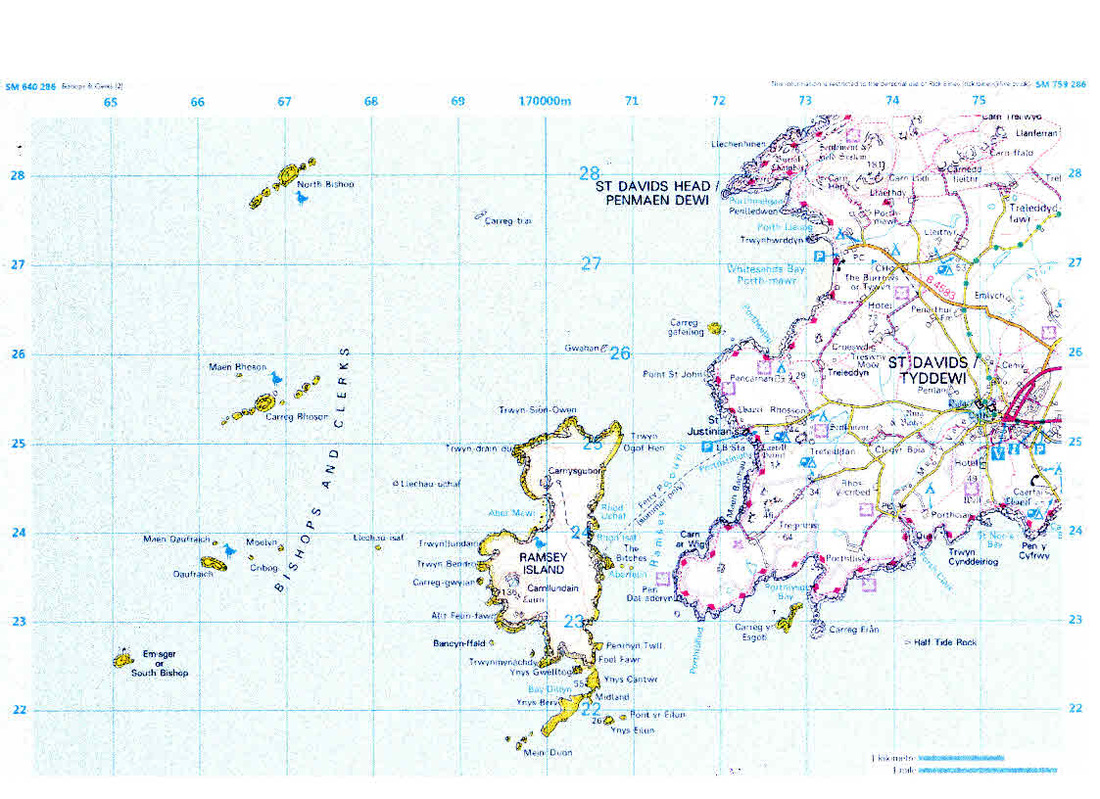
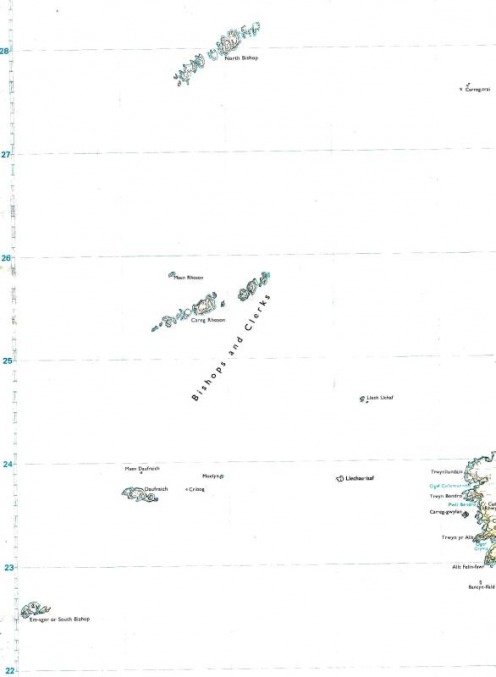
The fearsome rocks known as the Bishops and Clerks lie in a line offshore from St David's Head in the tidal waters which sweep up and down at running pace every day, every week, every month, every year, for thousands of years, billions of tons of water dragged in cycles in a tidal surge by a combination of the gravitational pull of the moon and sun. The sun has a massive gravity but is over 80 million miles away, the moon has a relatively small mass but because of its proximity it exerts the greater pull. The directional difference [or unity] of the combined forces of sun and moon create a cycle of neap tides and spring floods, reaching the dizzy heights of seven and threequarter metres [almost 28'] above mean low water. The race runs furiously on the spring flood, and in any sort of rough, windy weather this fury is dangerously big - especially when the tide runs against the wind. The surface of the tidal waters is ever changing, and compellingly lively. In the space of a few minutes I have sailed through dead flat but fast flowing water, with occasional knife-edged streams running in opposite directions [with attendant whirlpools], through chip chop wavelets, into huge overfalls often with 'stopper' waves, the largest of which are potentially very dangerous for small boats. They are best met at speed, head on, so that you burst through with ample momentum. Sideways on in a canoe is certainly not a good idea....
The group comprises four small rocky islands - North Bishop, Carreg Rhosson, Daufraich and South Bishop, aka Em-sger [two of these are groups of rocks, with some risky navigatable channels between....] called the Bishops, and there's a scattering of attendant Clerks [or "choristers" in George Owen's words - he was a local historian, an influencial squire of N. Pembrokeshire, living in the ancestral home at Henllys]. These are variously named descriptively in Welsh: Carreg Trai [Ebb-tide Rock]; Llech Uchaf [Upper Stone]; Gwahan [Separate - this one is directly north of Ramsey Island and still in the Sound]; Moelyn [Bare Top]; and Llechau Isaf, Maen Rhosson, Maen Daufraich, and although not perhaps part of the set of Clerks, Carreg Gafeiliog just off the headland out of Porth Sele leading towards St John's Point round the corner, at the north end of Ramsey Sound proper. St David's Head has an ancient name "Octopitarum Promontorium" which translates roughly as Headland of the Eight Perils, and many's the time I have witnessed close up the terrifying clash of the elemental rocks and water, and every time I made sure that I was down-tide-side of the compellingly fascinating view of each peril. And perils these rocks and reefs are, in the words of George Owen in around 1600, a constant danger to sailors:
"These rocks are accounted sore dangers to those that seeke Milford coming from the south-west seas - the Bishop and these his clerkes preache deadly doctrine to their winter audience, such poor seafaring men as are forcyd thether by tempest, onlie in one thing they are to be commended, they keepe residence better than the rest of the canons of that see are wont to do."
The sentiment was probably that of the vicar-choral [and organist] Thomas Tomkins [1572 - 1656]. Tomkins was born in St Davids where his father was organist of the cathedral, and he lived in a house somewhere above Whitesands. Thomas was taught by William Byrd and in his early twenties became organist of both Worcester Cathedral and the Chapel Royal [from 1621]. He composed much church music, madrigals, part-songs and instrumental music. Evidently much admired as a composer, he wrote the music for the coronation of Charles 1st.
In 1810 Richard Fenton [who lived nearby at Rhosson] relates in his book 'A Historical Tour Through Pembrokeshire' the dramatic story of a rescue made in about 1780 by Blanch Williams of Treleddyn - our local farm - of some Swedish mariners shipwrecked on one of George Owen's aptly described 'choristers', and seemed doomed to drown in the ever-rising tide:
'About thirty years ago a Swedish vessel laden with iron etc. was wrecked on these rocks, but the crew, with the exception of one only, were saved by taking refuge on one of the smaller rocks in the train of the Great Bishop (one of the choristers, Geo. Owen would have called it), where their existence seemed to them protracted only to give death more terrors; for, without covering, food, or any hopes of escape, they considered their fate as inevitable. But a gentlewoman, Mrs. Williams, whose mansion of Trelethin faced that rock, and who was in the habit of viewing this tempestuous ocean through a telescope often in the day, providentially discovered those forlorn mariners just as they were beginning to carve their melancholy story on the rock, having resigned themselves to their fate; and immediately launching a boat in the creek below her house, notwithstanding the boisterousness of the weather, had the satisfaction to snatch from the jaws of fate, just ready to close on them, seven of her fellow-creatures, who, under her roof, till they had recovered their strength and spirits, experienced, as every other child of distress ever did, that kind and christian-like treatment which made them almost forget their misfortunes.'
I have often wondered which rocks the hapless but ultimately fortunate sailors were on after their shipwreck. Carreg Trai would fit the tale well - nearest St David's Head and exposed only from half tide. No-one would survive long here! From Trelethin [sic - now spelled Treleddyn] she would, I suppose, not see most of the little 'choristers' to the south, the other side of Ramsey, nor would she see Gwahan. The other possibility is that the mariners were as close by as Carreg Gafeiliog, only just a few hundred yards off Porth Sele - but still a wet and exposed place to be, especially in stormy conditions. These do not dry out entirely.... My hunch is Carreg Trai, halfway to what I have always known as "Sunset Island" [North Bishop] which are the only rocks she would have seen which would be covered by the rising tide. Now I have on thousands of occasions set sail from Porth Sele, against the incoming waves. Even the slightest surf has the power to undo you, if the wave catches the boat badly, and it is very hard to get a momentum needed to burst through. The storm winds are nearly always from the west, and by the description 'boisterousness of the weather' I assume a gale or less from the west, with corresponding swell. An easterly gale blows the sea flat, and there is not much surf on the beach. Sailing out is comparatively easy, with a following wind. No - my hunch sees the shivering men on Carreg Trai, seeing their fate - the sea - ever rising to lap around their ankles and hiss death within the hour by sweeping them off their little haven. And Blanch Williams set out 'at once' from 'the creek below her house' - presumably Porth Sele - displaying in equal measure enormous courage, skill and strength in single-handedly dragging her boat to the water, and then making a passage over a lively surf AND avoiding the many rocks off the beach, sailing across to the sailors and somehow getting them all safely on board, whilst maintaining control in the tidal waters. I suspect she might have reached them on the turn of the tide, the so-called slack-water. But no mention is made of where the Swedish vessel struck rocks - maybe she didn't, but was merely swamped by waves, despite what the narrative supposes? Maybe she was over-laden and too low in the water? In which case maybe she was sinking as she rounded St David's Head and the crew jumped ship for what appeared the relative safety of Carreg Trai - and one poor soul didn't make it, and was swept helplessly away to his death by drowning in the fearsome race?....
We cannot know the answers, but can appreciate the grey-cold dangers of these tidal waters.
There are many further tales to relate, experiences to share and fascinating facts to describe about these waters and the rocks, which I shall do over the next few weeks. But first I must post the first part of a mighty symphony I am composing which attempts to describe the raw power, the beauty, the ever-changing moods of this archipelago; the sheer unstoppable mass of water flowing to and fro, the light, the darkness, the bleakness, the spirituality of the place; the immutable constancy of the islands' presence. This opening movement - "The Flow" - lays down some of the motivic detail which I shall use in the other five [or six] movements
The group comprises four small rocky islands - North Bishop, Carreg Rhosson, Daufraich and South Bishop, aka Em-sger [two of these are groups of rocks, with some risky navigatable channels between....] called the Bishops, and there's a scattering of attendant Clerks [or "choristers" in George Owen's words - he was a local historian, an influencial squire of N. Pembrokeshire, living in the ancestral home at Henllys]. These are variously named descriptively in Welsh: Carreg Trai [Ebb-tide Rock]; Llech Uchaf [Upper Stone]; Gwahan [Separate - this one is directly north of Ramsey Island and still in the Sound]; Moelyn [Bare Top]; and Llechau Isaf, Maen Rhosson, Maen Daufraich, and although not perhaps part of the set of Clerks, Carreg Gafeiliog just off the headland out of Porth Sele leading towards St John's Point round the corner, at the north end of Ramsey Sound proper. St David's Head has an ancient name "Octopitarum Promontorium" which translates roughly as Headland of the Eight Perils, and many's the time I have witnessed close up the terrifying clash of the elemental rocks and water, and every time I made sure that I was down-tide-side of the compellingly fascinating view of each peril. And perils these rocks and reefs are, in the words of George Owen in around 1600, a constant danger to sailors:
"These rocks are accounted sore dangers to those that seeke Milford coming from the south-west seas - the Bishop and these his clerkes preache deadly doctrine to their winter audience, such poor seafaring men as are forcyd thether by tempest, onlie in one thing they are to be commended, they keepe residence better than the rest of the canons of that see are wont to do."
The sentiment was probably that of the vicar-choral [and organist] Thomas Tomkins [1572 - 1656]. Tomkins was born in St Davids where his father was organist of the cathedral, and he lived in a house somewhere above Whitesands. Thomas was taught by William Byrd and in his early twenties became organist of both Worcester Cathedral and the Chapel Royal [from 1621]. He composed much church music, madrigals, part-songs and instrumental music. Evidently much admired as a composer, he wrote the music for the coronation of Charles 1st.
In 1810 Richard Fenton [who lived nearby at Rhosson] relates in his book 'A Historical Tour Through Pembrokeshire' the dramatic story of a rescue made in about 1780 by Blanch Williams of Treleddyn - our local farm - of some Swedish mariners shipwrecked on one of George Owen's aptly described 'choristers', and seemed doomed to drown in the ever-rising tide:
'About thirty years ago a Swedish vessel laden with iron etc. was wrecked on these rocks, but the crew, with the exception of one only, were saved by taking refuge on one of the smaller rocks in the train of the Great Bishop (one of the choristers, Geo. Owen would have called it), where their existence seemed to them protracted only to give death more terrors; for, without covering, food, or any hopes of escape, they considered their fate as inevitable. But a gentlewoman, Mrs. Williams, whose mansion of Trelethin faced that rock, and who was in the habit of viewing this tempestuous ocean through a telescope often in the day, providentially discovered those forlorn mariners just as they were beginning to carve their melancholy story on the rock, having resigned themselves to their fate; and immediately launching a boat in the creek below her house, notwithstanding the boisterousness of the weather, had the satisfaction to snatch from the jaws of fate, just ready to close on them, seven of her fellow-creatures, who, under her roof, till they had recovered their strength and spirits, experienced, as every other child of distress ever did, that kind and christian-like treatment which made them almost forget their misfortunes.'
I have often wondered which rocks the hapless but ultimately fortunate sailors were on after their shipwreck. Carreg Trai would fit the tale well - nearest St David's Head and exposed only from half tide. No-one would survive long here! From Trelethin [sic - now spelled Treleddyn] she would, I suppose, not see most of the little 'choristers' to the south, the other side of Ramsey, nor would she see Gwahan. The other possibility is that the mariners were as close by as Carreg Gafeiliog, only just a few hundred yards off Porth Sele - but still a wet and exposed place to be, especially in stormy conditions. These do not dry out entirely.... My hunch is Carreg Trai, halfway to what I have always known as "Sunset Island" [North Bishop] which are the only rocks she would have seen which would be covered by the rising tide. Now I have on thousands of occasions set sail from Porth Sele, against the incoming waves. Even the slightest surf has the power to undo you, if the wave catches the boat badly, and it is very hard to get a momentum needed to burst through. The storm winds are nearly always from the west, and by the description 'boisterousness of the weather' I assume a gale or less from the west, with corresponding swell. An easterly gale blows the sea flat, and there is not much surf on the beach. Sailing out is comparatively easy, with a following wind. No - my hunch sees the shivering men on Carreg Trai, seeing their fate - the sea - ever rising to lap around their ankles and hiss death within the hour by sweeping them off their little haven. And Blanch Williams set out 'at once' from 'the creek below her house' - presumably Porth Sele - displaying in equal measure enormous courage, skill and strength in single-handedly dragging her boat to the water, and then making a passage over a lively surf AND avoiding the many rocks off the beach, sailing across to the sailors and somehow getting them all safely on board, whilst maintaining control in the tidal waters. I suspect she might have reached them on the turn of the tide, the so-called slack-water. But no mention is made of where the Swedish vessel struck rocks - maybe she didn't, but was merely swamped by waves, despite what the narrative supposes? Maybe she was over-laden and too low in the water? In which case maybe she was sinking as she rounded St David's Head and the crew jumped ship for what appeared the relative safety of Carreg Trai - and one poor soul didn't make it, and was swept helplessly away to his death by drowning in the fearsome race?....
We cannot know the answers, but can appreciate the grey-cold dangers of these tidal waters.
There are many further tales to relate, experiences to share and fascinating facts to describe about these waters and the rocks, which I shall do over the next few weeks. But first I must post the first part of a mighty symphony I am composing which attempts to describe the raw power, the beauty, the ever-changing moods of this archipelago; the sheer unstoppable mass of water flowing to and fro, the light, the darkness, the bleakness, the spirituality of the place; the immutable constancy of the islands' presence. This opening movement - "The Flow" - lays down some of the motivic detail which I shall use in the other five [or six] movements

View from Whitesands to the Bishops: from L to R - South Bishop, Daufraich, Carreg Rhosson and North Bishop [aka Sunset Island]

view from Aber West [in St Brides Bay] towards south end of Ramsey where the Rechabite floundered. South Bishop is behind Ramsey. Porth Clais, the little harbour she set sail from, is just this side of the small island in the mid distance.This picture is done with pastels.
There have been numerous shipwrecks of course on these rocks - tons of shipping lies below the surface, washed now daily by the ebb-and-flow of this enormous tidal race just as the rocks themselves are scoured. The wildlife looks on and avails itself of the facility of these remote places. When I have sailed out here I have seen all those deep-sea birds, the ocean travellers, that are rare by the shore; and the dolphins and porpoises abound here, as well as the larger whales [I have seen Risso's Dolphins out in the deep]; and of course there are hundreds of grey seals, which haul themselves onto the rocks for rest and social interchange.
One of the rocks is called Bell Rock [by North Bishop] and I have included an evocative tolling at the end of "The Flow". There are not actually any bell-ringing wreck buoys; the sea is too rough, too strong, and such buoys would themselves be a considerable hazard. The whole archipelago might appear rather romantic from our shore viewpoint, but as seen from either the north or south they present an awesome sight, like fate creeping up to undo you in your boat, to threaten the sanctuary of your vessel. The inevitability of your boat meeting with these rocks is unavoidable, with such strong tides, and the concentration required to navigate safely past all of them is a nervous one! You think you know where they all are, but it is so, so easy to become confused about exactly where you are, and the hazards rear up on you so very fast. One 19th century sailor described the Bishops & Clerks as being -
- "like so many heads of gaping monstors ready to devour, watching as fancied dragons, with gaping mouths, fiery hissing tongues, and snorting iron snouts".
One of the rocks is called Bell Rock [by North Bishop] and I have included an evocative tolling at the end of "The Flow". There are not actually any bell-ringing wreck buoys; the sea is too rough, too strong, and such buoys would themselves be a considerable hazard. The whole archipelago might appear rather romantic from our shore viewpoint, but as seen from either the north or south they present an awesome sight, like fate creeping up to undo you in your boat, to threaten the sanctuary of your vessel. The inevitability of your boat meeting with these rocks is unavoidable, with such strong tides, and the concentration required to navigate safely past all of them is a nervous one! You think you know where they all are, but it is so, so easy to become confused about exactly where you are, and the hazards rear up on you so very fast. One 19th century sailor described the Bishops & Clerks as being -
- "like so many heads of gaping monstors ready to devour, watching as fancied dragons, with gaping mouths, fiery hissing tongues, and snorting iron snouts".
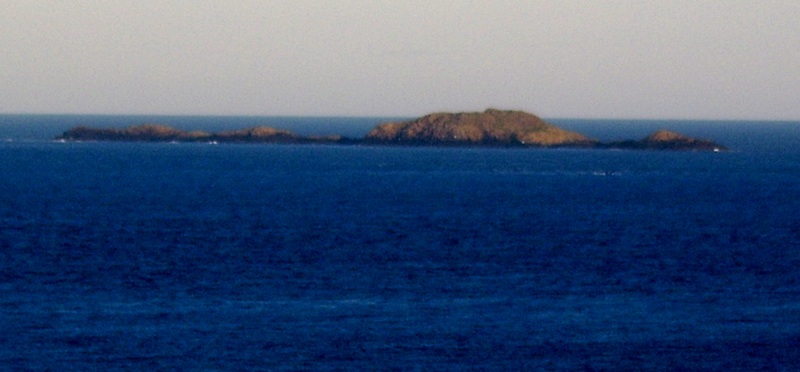
North Bishop - aka 'Sunset Island'. Carreg Trai can just be seen below it (the white water)
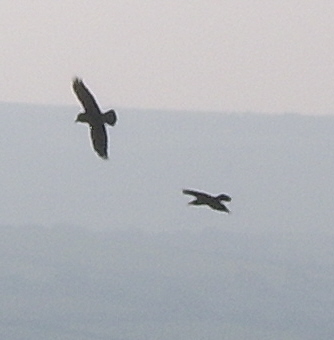
A pair of Ravens, kings of the air.

Carreg Rhosson , past Gwahan and Carreg Gafeiliog in the foreground
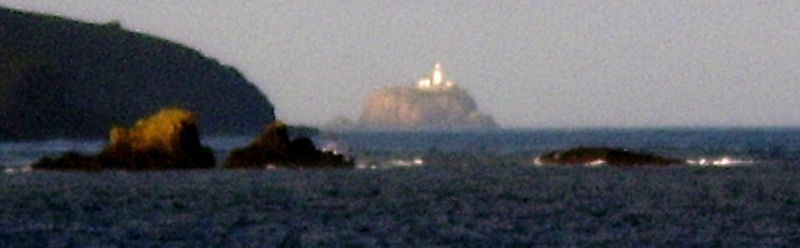
The distant South Bishop (with lighthouse) past Carreg Gafeiliog and the north end of Ramsey Island
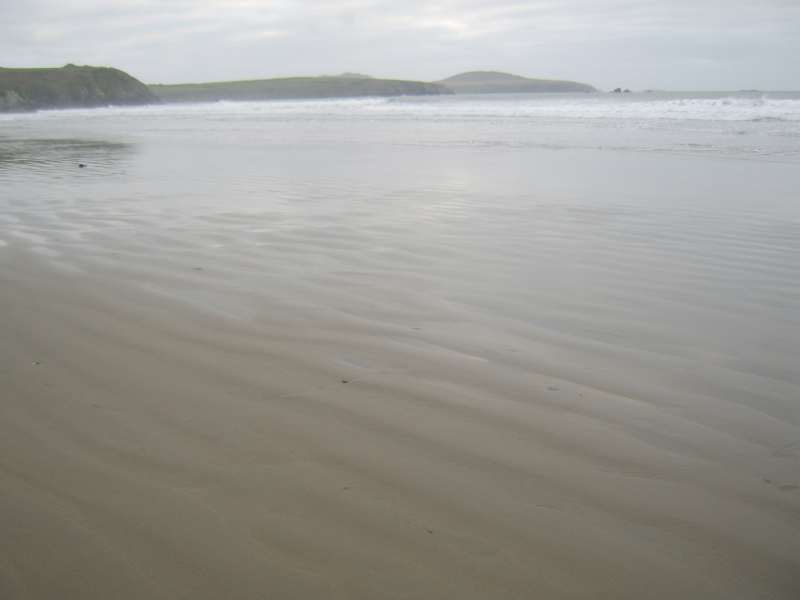
view towards Bishops & Clerks from Whitesands

*Update - March 2011:
I contacted the BBC National Orchestra of Wales and received the following advice from the Orchestral Manager:
"The BBC National Orchestra of Wales is committed to championing Welsh orchestral music but as you might imagine, is approached regularly by many composers wishing to have their music performed by us. In order to cope with the large number of approaches, we have set up our Welsh Composers Showcase events. We invite applications and score submissions in the autumn which are then assessed (by one of our conducting team) and a shortlist of pieces are selected for rehearsal and public performance by the orchestra around February time. The event takes place in BBC Hoddinott Hall. You would be most welcome to submit your Symphonic Poems for consideration and if you are interested in this, please keep a close eye on our website around September time where you will find details on how to apply."
and later:
"The aim of the Welsh Composers' Showcase is to highlight works by living composers worthy of wider exposure and is organised in collaboration with Composers and Wales, Ty Cerdd and the Welsh Music Guild."
Then the restrictions....
Composers eligible to submit a score are as follows:
So that counts me out! I find the argument that all these professional orchestras give about being approached by too many people interested in having their scores considered for performance shamefully weak. It would be eminently feasible to have a range of filtering systems - eager volunteers with enough musical nous to form a fair judgement about the basic competence of a submitted score, who would pass on suitable material for further consideration to a more senior assessor, and so on through increasingly rigorous critical filtering to the conductor who would make a decision about whether or not to perform (even just in rehearsal) the music. This would be a fair and inclusive process - no eligibility criteria other than the worth of the music. No nationality barriers, no age barriers, no 'where were you born/educated' barriers, in fact no barriers at all. Why have barriers?
Then any half-decent music could have a fair chance of being played, of being heard, of being assessed. Culturally this would surely be a positive thing to do! As it is the world of professional performance is closed to composers like me. Some of us may possibly be composing really good music, but who will ever get to hear this under present systems? Instead we hear the establishment over and over ad nauseam - endless repeats of 'safe' music. And some of the music played is not particularly good.
He also said:
"You mention that your wish is to have these performed in St. Davids Cathedral. We only appear at St Davids by invitation of the St Davids and Fishguard Festivals, and the repertoire we play there is decided between the festivals, our producer and BBC Radio 3's requirements. In fact, all our mainstream concert repertoire has to be approved by Radio 3."
I did approach the St David's Cathedral organist but received this reply:
"In terms of performance, I am not sure if I can help though. The BBC National Orchestra of Wales visits our Festival each year to give a concert, but I have no control whatsoever over the content of their concert, as this is decided by their own programmers several years in advance!"
So there it is. All pillars and posts. I might be composing music which is deeply imbued with local detail and which is as embedded in local Welsh cultural reference as is possible to be, yet it cannot be considered even by Wales' very own National Orchestra, nor by the very centre of cultural identity, St David's Cathedral. That I have been a part of Pembrokeshire throughout my life - over 60 years - and know the place intimately counts for little. I gained my BMus. at UCW Aberystwyth; I used to sing sometimes in the St Davids Cathedral choir; my family's history on my father's side (Morgans) is rooted in Swansea, the Mumbles & the Gower; my father was brought up speaking some Welsh; my Granny played hockey for Glamorgan; her brother is commemorated on the Mumbles WW1 Memorial (he lost a leg but still carried on flying in the Air Corps before being killed in a plane crash near Canterbury). I am beginning to think that there is some Machiavellian plot to prevent me ever hearing any of my music.....what is wrong with our professional orchestras, for goodness sake? It is deeply frustrating.
This is my rant!...
"The BBC National Orchestra of Wales is committed to championing Welsh orchestral music but as you might imagine, is approached regularly by many composers wishing to have their music performed by us. In order to cope with the large number of approaches, we have set up our Welsh Composers Showcase events. We invite applications and score submissions in the autumn which are then assessed (by one of our conducting team) and a shortlist of pieces are selected for rehearsal and public performance by the orchestra around February time. The event takes place in BBC Hoddinott Hall. You would be most welcome to submit your Symphonic Poems for consideration and if you are interested in this, please keep a close eye on our website around September time where you will find details on how to apply."
and later:
"The aim of the Welsh Composers' Showcase is to highlight works by living composers worthy of wider exposure and is organised in collaboration with Composers and Wales, Ty Cerdd and the Welsh Music Guild."
Then the restrictions....
Composers eligible to submit a score are as follows:
- Post tertiary education composers born in Wales
- Post tertiary education composers currently living in Wales
- Composers studying composition at Post-Graduate level in Wales
- Composers born in Wales studying composition at Post-Graduate level outside Wales but within the U.K.
So that counts me out! I find the argument that all these professional orchestras give about being approached by too many people interested in having their scores considered for performance shamefully weak. It would be eminently feasible to have a range of filtering systems - eager volunteers with enough musical nous to form a fair judgement about the basic competence of a submitted score, who would pass on suitable material for further consideration to a more senior assessor, and so on through increasingly rigorous critical filtering to the conductor who would make a decision about whether or not to perform (even just in rehearsal) the music. This would be a fair and inclusive process - no eligibility criteria other than the worth of the music. No nationality barriers, no age barriers, no 'where were you born/educated' barriers, in fact no barriers at all. Why have barriers?
Then any half-decent music could have a fair chance of being played, of being heard, of being assessed. Culturally this would surely be a positive thing to do! As it is the world of professional performance is closed to composers like me. Some of us may possibly be composing really good music, but who will ever get to hear this under present systems? Instead we hear the establishment over and over ad nauseam - endless repeats of 'safe' music. And some of the music played is not particularly good.
He also said:
"You mention that your wish is to have these performed in St. Davids Cathedral. We only appear at St Davids by invitation of the St Davids and Fishguard Festivals, and the repertoire we play there is decided between the festivals, our producer and BBC Radio 3's requirements. In fact, all our mainstream concert repertoire has to be approved by Radio 3."
I did approach the St David's Cathedral organist but received this reply:
"In terms of performance, I am not sure if I can help though. The BBC National Orchestra of Wales visits our Festival each year to give a concert, but I have no control whatsoever over the content of their concert, as this is decided by their own programmers several years in advance!"
So there it is. All pillars and posts. I might be composing music which is deeply imbued with local detail and which is as embedded in local Welsh cultural reference as is possible to be, yet it cannot be considered even by Wales' very own National Orchestra, nor by the very centre of cultural identity, St David's Cathedral. That I have been a part of Pembrokeshire throughout my life - over 60 years - and know the place intimately counts for little. I gained my BMus. at UCW Aberystwyth; I used to sing sometimes in the St Davids Cathedral choir; my family's history on my father's side (Morgans) is rooted in Swansea, the Mumbles & the Gower; my father was brought up speaking some Welsh; my Granny played hockey for Glamorgan; her brother is commemorated on the Mumbles WW1 Memorial (he lost a leg but still carried on flying in the Air Corps before being killed in a plane crash near Canterbury). I am beginning to think that there is some Machiavellian plot to prevent me ever hearing any of my music.....what is wrong with our professional orchestras, for goodness sake? It is deeply frustrating.
This is my rant!...